

Decoding the News
June Fourth and the Right to Development


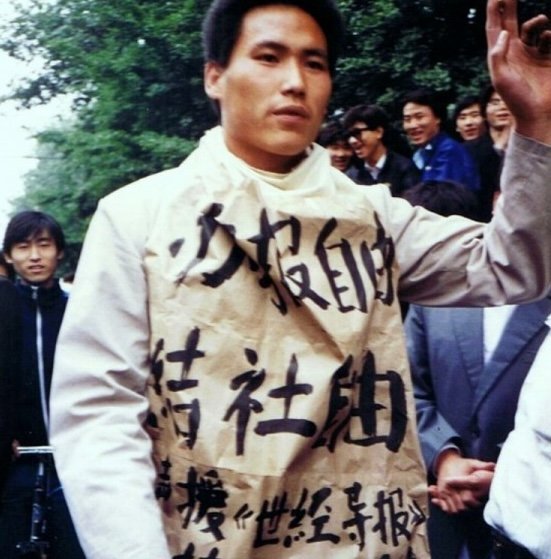
This past week marked the 37th anniversary of the brutal suppression of a peaceful protest movement on Beijing’s Tiananmen Square in which people from all walks of life, many of them young students, were killed because they advocated for political reform and an end to corruption. The protests that unfolded across the country in the spring of 1989 were an insistent cry for fundamental human rights and democracy, hopes that were met with tanks and bullets. Nearly four decades later, the date is unmentionable inside China, and the world’s most sophisticated system of media and internet censorship ensures that commemoration is virtually impossible.
But an important part of the erasure of this anniversary is achieved also today by the leadership’s amplification of an alternate vision of human rights, one centered on the idea that “development” is the foremost human right. On its front page, just under the masthead, the official People’s Daily mentions “development” 20 times in a single tribute to Xi Jinping’s “heartfelt concern for the people” (人民情怀), a Party formula that in this instance means measuring the leader’s bond with ordinary citizens through the provision of goods, including healthcare, education and economic well-being, over political participation and civil rights. The headline goes further in declaring the Party’s development vision as a vision for the whole world: “China Can Succeed, and So Can Other Developing Countries,” it reads.
The phrase “not leaving a single person behind” (不让一个人掉队) echoes theUnited Nations Sustainable Development Goals’ core pledge to “leave no one behind.” But the understanding of how this is to be achieved differs markedly from the SDG vision of civic participation in development,conveyed in SDG 16, which recognizes “the need to build peaceful, just and inclusive societies that provide equal access to justice and that are based on respect for human rights, on effective rule of law and good governance at all levels.” People’s Daily speaks of “people-centered development” (以人民为中心的发展), a common trope according to which it is the Party, not the public or the individual, that determines what the people need. Xi is quoted as declaring that “the aspiration of all peoples for a better life is our pursuit.” This follows a persistent CCP position that “a prosperous people’s life,” understood in material terms, is the highest form of human rights. “Subsistence is the foundation of all human rights; a prosperous people’s life is the greatest human right,” Xi has often been quoted as saying in a May 2022 People’s Daily series devoted to the subject.
This development-centered view of human rights dates back to the aftermath of June Fourth. China published its first White Paper on Human Rights in 1991, issued in direct response to international criticism of the Tiananmen crackdown. The paper began by relativizing the concept as set out in the UN’s International Covenant on Civil and Political Rights and International Covenant on Economic, Social and Cultural Rights and asserting the notion of “Chinese human rights” conditioned on the country’s unique characteristics: “Owing to tremendous differences in historical background, social system, cultural tradition and economic development, countries differ in their understanding and practice of human rights,” it read.
China’s state-centric, relativist conception of human rights systematically excludes civil and political rights, prioritizing instead “the right to subsistence” and the right to development — elevating economic growth and stability above individual freedoms. Beijing has carried this framework into the international arena by inserting concepts like “a community of shared future” into UN Human Rights Council resolutions and sponsoring resolutions that recast human rights as a matter of state-to-state cooperation rather than individual accountability, effectively working to reshape global human rights governance in its own image.


